Was There a Particular Reason That the King of France Became Interested in Founding an Art Academy?
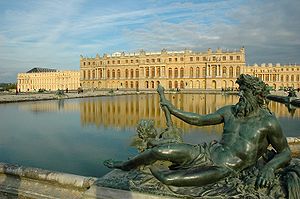
The Louis XIV style or Louis Quatorze ( LOO-ee ka-TORZ, - kə-, French: [lwi katɔʁz] (  listen )), besides called French classicism, was the way of architecture and decorative arts intended to glorify King Louis Xiv and his reign. It featured majesty, harmony and regularity. It became the official style during the reign of Louis XIV (1643–1715), imposed upon artists by the newly established Académie royale de peinture et de sculpture (Royal University of Painting and Sculpture) and the Académie royale d'architecture (Royal Academy of Architecture). It had an important influence upon the architecture of other European monarchs, from Frederick the Great of Prussia to Peter the Great of Russia. Major architects of the period included François Mansart, Jules Hardouin Mansart, Robert de Cotte, Pierre Le Muet, Claude Perrault, and Louis Le Vau. Major monuments included the Palace of Versailles, the Grand Trianon at Versailles, and the Church building of Les Invalides (1675–91).
The Louis XIV mode had three periods. During the first menstruum, which coincided with the youth of the Male monarch (1643-1660) and the regency of Anne of Austria, compages and art were strongly influenced by the before style of Louis XIII and by the Baroque way imported from Italy. The early on period saw the beginning of French classicism, particularly in the early works of Francois Mansart, such every bit the Chateau de Maisons (1630–51). During the second flow (1660-1690), under the personal rule of the King, the style of architecture and decoration became more than classical, triumphant and ostentatious, expressed in the building of the Chateau of Versailles, kickoff by Louis Le Vau and then Jules Hardouin-Mansart.[1] Until 1680, furniture was massive, decorated with a profusion of sculpture and gilding. In the subsequently period, thanks to the development of the craft of marquetry, the furniture was decorated with unlike colors and different woods. The most prominent creator of article of furniture in the later catamenia was André Charles Boulle.[2] The last catamenia of Louis XIV manner, from nearly 1690 to 1715, is chosen the flow of transition; information technology was influenced past Hardouin-Mansart and by the King's designer of fetes and ceremonies, Jean Bérain the Elder. The new style was lighter in course, and featured greater fantasy and liberty of line, thanks in part to the employ of wrought iron decoration, and greater use of arabesque, grotesque and coquille designs, which continued into the Louis XV mode.[iii]
Civil architecture [edit]
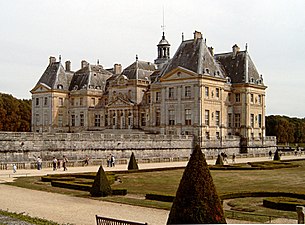
The model of civil architecture in the early function of the reign was Vaux le Vicomte (1658), by Louis Le Vau, built for the King'due south chief of finance Nicolas Fouquet and completed in 1658. Louis XIV charged Fouquet with theft, put him prison, and took the building for himself. The design was strongly influenced by the classicism of François Mansart. Information technology combined a facade dominated and rhymed by jumbo classical columns, below a dome, imported from the Italian Bizarre compages, along with a number of original features, such as a semicircular salon which looked out on the vast French formal garden created by André Le Nôtre.[4]
Based on the success of Vaux le Vicomte, Louis Xiv selected Le Vau to construct an immense new palace at Versailles, to augment a smaller palace transformed from a hunting gild past Louis XIII. This gradually became, over the decades, the master work of the Louis Xiv style. Following the death of Le Vau in 1680, Jules Hardouin-Mansart took over the Versailles project; he broke away from the picturesque projections and dome and made a more sober and uniform facade of columns, with a flat roof topped by a balustrade and row of columns (1681). He used the same style to harmonize the other new buildings he created at Versailles, including the Orangerie and the Stables. Hardouin-Mansart constructed the Grand Trianon (completed 1687), single-story royal retreat with arched windows alternating with pairs of columns, and a flat roof and balustrade.
Some other major new projection undertaken by Louis was the construction of a new facade for the eastward side of the Louvre. In 1665 Louis invited the nigh famous sculptor architect of the Italian Baroque, Gian Lorenzo Bernini, to submit a design, just in 1667 rejected it in favor of a more sober and classical colonnade, designed by a commission of three, comprising Louis Le Vau, Charles Le Brun, and Claude Perrault.


Religious architecture [edit]
In the early menses of his reign, Louis began building the church building of Val-de-Grâce (1645–1710), the chapel of the Val-de-Grace hospital. The design was worked on successively by Mansart, Jacques Lemercier and Pierre Le Muet before being completed by Gabriel Leduc. Its picturesque tripartite facade, peristyle, discrete columns, statues, and tondi, brand information technology the most Italianate and Baroque of Paris churches. It served as the prototype for the later domes of Les Invalides and the Pantheon.[5]
The side by side major church congenital under Louis 14 was the church of Les Invalides (1680–1706). The nave of the church, by Libéral Bruant, was comparable to those of other churches of the period, with ionic pilasters and penetrating vaults, and an interior that resembled the high baroque style. The dome, past Hardouin-Mansart, was more revolutionary, sitting upon a structure with the plan of a Greek Cantankerous. The design used superimposed orders of columns, in the classical fashion, but the dome achieved greater height, past resting on a double tambouror pulsate, and the facade and dome itself were richly busy with sculptures, entablements in niches, and ornaments of gilded bronze alternate with the nervures, or ribs of the dome.[5]
The finest church interior of the late Louis XIV flow is the chapel of the Chateau of Versailles, created between 1697 and 1710 by Hardouin-Mansart and his successor as court architect, Robert de Cotte. The decor was carefully restrained, with light colors and sculptural item in slight relief on the columns. The interior of the chapel opened upwards and lightened by the use of classical columns placed on the tribune, i level higher up the ground floor, to support the weight of the vaulted ceiling.[five]


The Yard Way: Paris [edit]
Though Louis 14 was later defendant of having ignored Paris, his reign saw several massive architectural projects which opened up space and ornamented the center of the city. The idea of monumental urban squares surrounded by compatible compages had begun in Italy, like many architectural ideas of Baroque period. The first such square in Paris was the Identify Royal (at present Place des Vosges) begun past Henry IV of France, completed later with an equestrian statue of Louis 13; and so the Place Dauphine on the Ile de la Cité, which featured, adjacent to it, an equestrian statue of Henry Four. The initial grand Paris projects of Louis 14 were new facades on the Louvre, especially the Collonade,facing to the east. These were showcases of the new awe-inspiring style of Louis Fourteen. The sometime brick and stone of the Henry IV squares was replaced by the M Way of monumental columns, which usually were function of the facade itself, rather than standing separately. All the buildings around the square were connected and built to the same height, in the same fashion. The ground floor featured a covered arcade for pedestrians.[6]
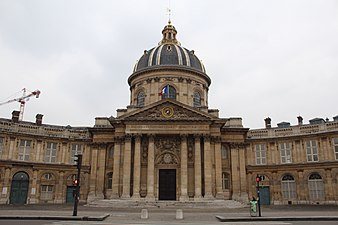
The starting time such circuitous of buildings congenital under Louis 14 was the Collège des Quatre-Nations (now the Institut de France) (1662–68), facing the Louvre. It was designed by Louis Le Vau and François d'Orbay, and combined the new higher donated by Mazarin, a chapel, and the library of Fundamental Mazarin. (Subsequently, equally the Institute of French republic, it would get the headquarters of the academies founded by the King.) The Hôtel Royal des Invalides – a complex for war veterans consisting of residences, a hospital, and a chapel – was constructed past Libéral Bruant and Jules Hardouin-Mansart (1671–1679). Louis Xiv then commissioned Mansart to construct a separate private royal chapel featuring a striking dome, the Église du Dôme, which was added to complete the complex in 1708.
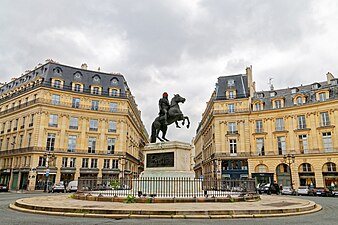
The next major project was the Place des Victoires (1684-1697), a real estate evolution of seven big buildings in three segments around a circular square, with a standing effigy statue of Louis Fourteen (later replaced with an equestrian statue) planned for the centerpiece. This was built by an enterprising entrepreneur and nobleman of the court, Jean-Baptiste Prédot, combined with the builder Jules Haroudin-Mansart. The terminal urban project became the all-time-known, the Place Vendôme, as well by Harouin-Mansart, between 1699 and 1702. Its centerpiece was an equestrian statue of Louis Fourteen (later replaced with a statue of Napoleon atop the Vendome Column). In another innovation, this projection was partially financed by the sale of lots around the square. All of these projects featured monumental facades in the Louis 14 mode, giving a item harmony to the squares.[7]

Interior decoration [edit]
In the early Louis XIV manner, the principle characteristics of decor were a richness of materials and an attempt to reach a monumental effect. The materials used included marble, ofttimes combined with multicolor stones, bronze, paintings, and mirrors. These were inserted into an extremely framework[ further explanation needed ] of columns, pilasters, niches, which extended up the walls and upwards upon the ceiling. The doors were surrounded with medallions, frontons and bas-reliefs. The fireplaces were smaller than those during the Louis Thirteen era, merely more ornate, with a marble shelf supporting vases, below a carved frame with a painting or mirrors, all surrounded by a thick edge of carved leaves or flowers.
Decorative elements on the walls of the early Louis Xiv manner were ordinarily intended to celebrate the military success, majesty and cultural achievements of the Rex. They often featured military trophies, with helmets, oak leaves symbolizing victory, and masses of weapons, usually made of glided bronze or sculpted woods, in relief surrounded past marble. Other decorative elements celebrated the King personally: the head of the Rex was often represented as the lord's day god Apollo, surrounded by palm leaves or gilded rays of light. An eagle usually represented Jupiter. Other ornamental details included gilded numbers, royal batons, and crowns.
The Hall of Mirrors of the Palace of Versailles (1678–1684) was the summit of the early Louis XIV style. Designed by Charles Le Brun, it combined a richness of materials (marble, gold, and bronze) which reflected in the mirrors.
In the belatedly Louis 14 period, after 1690, new elements began to announced, that were less militaristic and more fantastic; specially seashells, surrounded past elaborate sinuous lines and curves; and exotic designs, including arabesques and Chinoiserie.[eight]
-

Early Louis XIV way; the Salon de Vénus at the Palace of Versailles by Charles Le Brun
-

Later Louis Fourteen fashion; mosaics in the salon of the Oeil-de-Boeuf at Versailles
Article of furniture [edit]
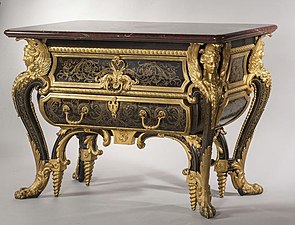
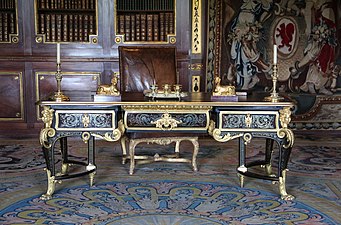
During the first menstruation of the reign of Louis XIV, furniture followed the previous style of Louis Xiii, and was massive, and profusely busy with sculpture and gilding. After 1680, thank you in large office to the furniture designer André Charles Boulle, a more original and fragile style appeared, sometimes known every bit Boulle piece of work. It was based on the inlay of ebony and other rare wood, a technique kickoff used in Florence in the 15th century, which was refined and developed by Boulle and others working for Louis XIV. Furniture was inlaid with plaques of ebony, copper, and exotic woods of different colors.[9]
New and often enduring types of article of furniture appeared; the commode, with two to four drawers, replaced the old coffre, or chest. The canapé, or sofa, appeared, in the form of a combination of two or iii armchairs. New kinds of armchairs appeared, including the fauteuil en confessionale or "Confessional armchair", which had padded cushions on either side of the dorsum of the chair. The console table also fabricated its first appearance; it was designed to be placed against a wall. Another new type of furniture was the tabular array à gibier, a marble-topped table for holding dishes. Early varieties of the desk-bound appeared; the Mazarin desk-bound had a key section set back, placed betwixt two columns of drawers, with four feet on each column.[10]
-
-

-
-

Sofa and chairs "a la reine" (1710–twenty), Louvre Museum
Ceramics [edit]
Later about 1650, Nevers faience (tin-glazed earthenware), which had long made wares in the Italian maiolica istoriato style, adopted the new French Court style, borrowing from metalwork and other decorative arts, and using prints afterward the new generation of court painters such equally Simon Vouet and Charles Lebrun for the images, which were also painted in many colours. The pieces were often extremely big and ornate, and apart from garden vases and wine-coolers, no doubt decorative rather than applied.[11]
In 1663 Colbert, recently fabricated Louis 14'south finance government minister, made a annotation that the other leading centre of French faience, Rouen faience, should be protected and encouraged, sent designs, and given commissions past the rex.[12] Around 1670 the Rouen factory of the Poterat family received part of the large and prestigious commissions for Louis XIV's Trianon de porcelaine, a small-scale palace whose walls were largely covered in painted tiles, in fact of faience rather than porcelain, which was demolished not long subsequently. Nevers and other centres shared these commissions, and others for large fittings and decorations for Louis'due south other palaces. Nevers garden vases in blue and white were prominently used in the gardens of the Chateau de Versailles.[13]
The French faience industry received some other huge boost when, belatedly in Louis's reign in 1709, the rex pressured the wealthy to donate their silvery plate, previously what they normally used to dine, to his treasury to help pay for his wars. They was an "overnight frenzy" as the elite rushed to go faience replacements of the best quality.[14]
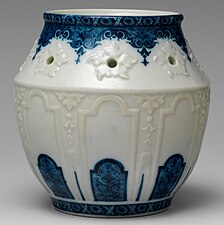
The reign as well saw the earliest French porcelain in Rouen porcelain, although product was on a tiny scale; but nine pocket-sized pieces are thought to survive.[15] The next factory, Saint-Cloud porcelain, from mayhap 1695 onwards, was more successful,[16] though information technology was only in the post-obit reign that French porcelain was produced in quantity.
-
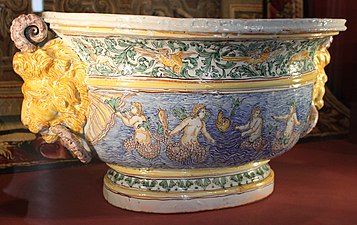
Nevers wine-cooler with The Drunkenness of Bacchus, c. 1680
-

Nevers pair of wine jugs, c. 1685, 56 cm loftier. François Chauveau's Rape of Europa is once more used (left).
-

Large Nevers ewer with dancing bacchantes and satyrs, 1685
-
Painting [edit]
In the first part of the reign, French painters were largely influenced by the Italians, particularly Caravaggio. Notable French painters included Nicolas Poussin, who was living in Rome; Claude Lorrain, who specialized in landscapes and spent most of his career in Rome; Louis Le Nain, who, along with his brothers, did mostly genre works; Eustache Le Sueur, and Charles Le Brun, who studied with Poussin in Rome and were influenced by him.
With the death in 1661 of Primal Mazarin, the Male monarch'due south prime minister, Louis decided to take personal accuse of all aspects of government, including the arts. His chief counselor on the arts was Jean Colbert (1619–1683), who was besides his finance government minister. In 1663 Colbert reorganized the Royal furniture workshops, which made a wide variety of luxury goods, and added to information technology the Gobelins tapestry workshops. At the same fourth dimension, with the help of Le Brun, Colbert took accuse of the Royal University of Painting and Sculpture, which had been founded by Primal Mazarin. Colbert also took a dominant office in compages, taking the title of Superintendent of buildings in 1664. In 1666, the French Academy in Rome was founded, to have advantage of Rome'southward position as the leading fine art heart of Europe, and to assure a stream of well-trained painters. Le Brun became the dean of French painters under Louis Fourteen, involved in architectural projects and interior blueprint. His notable decorative works included the ceiling of the Hall of Mirrors in the Palace of Versailles.[xviii]
The major painters of the later reign of Louis XIV included Hyacinthe Rigaud (1659–1743) who came to Paris in 1681, and attracted the attention of LeBrun. LeBrun oriented him toward portrait painting, and he made a historic portrait of Louis XIV in 1701, surrounded past all the attributes of ability, from the crown on the table to the ruby heels of his shoes. Rigaud shortly had an elaborate workshop in place for making portraits of the dignity; he employed specialized artists to create the costumes and draperies, and others to paint the backgrounds, ranging from battlefields to gardens to salons, while he concentrated on the composition, colors and especially the faces.[18]
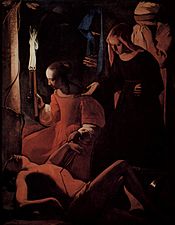
Georges de La Tour (1593–1652) was another of import figure in the Louis XIV mode; he was given a title, named court painter of the King, and received loftier payments for his portraits, though he rarely ever came to Paris, preferring to work in his abode boondocks of Lunéville. His paintings, with their unusual light and dark effects, were unusually somber, the figures barely seen in the darkness, lit past torchlight, evoking meditation and compassion. In addition to religious scenes, he did genre paintings, including the famous Tricheur or carte cheat, showing a young noble being cheated at cards while others look on passively. The writer and later French culture minister Andre Malraux wrote in 1951, "No other painter, not even Rembrandt, e'er suggested such a vast and mysterious silence. La Tour is the only interpreter of the serene aspect of shadows."[19]
In his last years, Louis XIV'due south tastes changed once more, under the influence of his morganic wife, Madame de Maintenon, toward more religious and meditative themes. He had all the paintings in his private room removed and replaced by a single canvas, Saint Sebastien being tended by Saint Irene (c. 1649) by Georges de La Tour.[20]

Sculpture [edit]
The most influential sculptor of the flow was the Italian Gian Lorenzo Bernini, whose work in Rome inspired sculptors all over Europe. He traveled to France; his proposal for a new facade of the Louvre was rejected by the King, who wanted a more specifically French manner, but the Bernini did make a bosom of Louis XIV in 1665 which was greatly admired and imitated in France.
One of the most prominent sculptors under Louis XIV was Antoine Coysevox (pronounced "qualzevo") (1640–1720) from Lyon. He studied sculpture under Louis Lerambert and copied in marble aboriginal Roman works, including the Venus de Medici. In 1776, his bust of the Rex's official painter Charles Le Brun won him admission to the Majestic Academy of Painting and Sculpture. He was presently producing monumental sculpture to accompany the new buildings constructed past Louis XIV; he fabricated a Charlemagne for the imperial chapel at Les Invalides, and then a big number of statues for the new Park at Versailles and then at the Chateau de Marly. He originally made the outdoor statues in weather-resistant stucco, and then replaced them with marble works when they were finished in 1705. His piece of work of Neptune from Marly is now in the Louvre, and his statues of Pan and a Flora and Dryad are at present institute in the Tuileries Gardens. His statue of The Rex's Fame riding Pegasus was originally made for the Chateau of Marly. Afterward the Revolution it was moved to the Tuileries Gardens, and is now within the Louvre. He also fabricated a series of profoundly admired portrait sculptures of the leading statesmen and artists of the time; Louis XIV at Versailles, Colbert (for his tomb at the Church building of Saint Eustache; Cardinal Mazarin in the Collège des Quatre-Nations (now the Institut de France) in Paris; the playwright Jean Racine; the builder Vauban and the garden designer Andre Le Notre.[21]
Jacques Sarazin was another notable sculptor working on projects for Louis XIV. He made many statues and decorations for the Palace of Versailles, as well as the Caryatids for the eastern facade of the Pavilion du Horloge of the Louvre, facing the Cour Carré, which were based both on a study of the original Greek models, and on the piece of work of Michelangelo.
Some other notable sculptor of the Style Louis XV was Pierre Paul Puget (1620–1694), who was a sculptor, painter, engineer and builder. He was built-in in Marseille, and first sculpted ornaments for ships under construction. He then travelled to Italy, where he worked every bit an apprentice on the Baroque ceilings of the Palazzo Barberini and Palazzo Pitti. He travelled back and forth between Italia and France, painting, sculpting and wood-etching. He fabricated his historic statue of caryatids for the city hall of Toulon in 1665–67, and then was employed by Nicolas Fouquet to brand a statue of Hercules for his chateau at Vaux-le-Vicomte. He continued to live in the south of France, making notable statues of Milo of Croton, Perseus and Andromeda (now in the Louvre).[22]
-

-

The King's Fame riding Pegasus, by Antoine Coysevox, made for Marly, now in the Louvre. (1702)
-

Tapestries [edit]
In 1662 Jean Baptiste Colbert purchased the tapestry workshop of a family of Flemish artisans and transformed it into a royal workshop for the industry of piece of furniture and tapestries, under the proper name of Gobelins tapestry. Colbert placed the workshop under the direction of the royal court painter, Charles Le Brun, who served in that position from 1663 until 1690. The workshop worked closely with the major painters of the court, who produced the designs. Later 1697 the enterprise was reorganized, and thereafter was devoted entirely to the production of tapestries for the King.[23]
The themes and styles of the tapestry were largely like to the themes in the paintings of the period, celebrating the majesty of the King and triumphal scenes of military victories, mythological and pastoral scenes. While at first they were made only for utilize of the Rex and dignity, the factory soon began exporting its products to the other courts of Europe.
The majestic Gobelins manufactory had competition from two private enterprises, the Beauvais Manufactory and the Aubusson tapestry workshop, which produced works in the same way only with a depression-warp process, with slightly bottom quality. Jean Bérain the Elderberry, the royal draftsman and designer of the King, created a serial of grotesque carpets for Aubusson. These tapestries sometimes historic contemporary themes, such as a piece of work designed by Aubusson An late 17th to early 18th century tapestry washed past the Beauvais Manufactory depicting Chinese astronomers at the Beijing Ancient Observatory using new more accurate instruments brought to them by Europeans (Jesuits) which were installed in 1644.
Design and spectacle [edit]
In the early years of the Male monarch's reign, the most important public royal ceremony was the carrousel, a series of exercises and games on horseback. These events were designed to supercede the tournament, which had been banned after 1559 when Rex Henry 2 was killed in a jousting blow. In the new, less dangerous version, riders usually had to laissez passer their lance through the interior of a ring, or strike mannequins with the heads of Medusa, Moors and Turks. A grand carrousel was held on June 5–six, 1662 to celebrate the birth of the Dauphin, the son of Louis XIV. It was held on the square separating the Louvre from the Tuileries Palace, which later became known equally the Place du Carrousel.[24]
The ceremonial entry of the King into Paris too became an occasion for festivities. The render of Louis XIV and Queen Marie-Thérèse to Paris subsequently his coronation in 1660 was celebrated by a 1000 event on a fairground at the gates of the city, where big thrones were constructed for the new monarchs. After the ceremony the site became known as the Place du Trône, or identify of the Throne, until it became the Identify de la Nation in 1880.[25]
An office existed in the royal household of Louis XIV called Menus-Plaisirs du Roi, which was responsible the decoration at royal ceremonies and spectacles, including ballets, masques, illuminations, fireworks, theater performances and other entertainments. This office was held from 1674 to 1711 by Jean Bérain the Elder (1640-1711). He was also designer of the King's bedchamber and offices, and had an enormous influence upon what became known as the Manner Louis XIV; his studio was located in the Grand Gallery of the Louvre, forth with those of the purple furniture designer André Charles Boulle. He was specially responsible for introducing the a modified version of the grotesque mode of ornamentation, originally created in Italy by Raphael, into French interior design. He used the grotesque stele not only on wall panels, but also on tapestries made by the Aubusson tapestry workshops. His many varied other designs included the highly-ornate blueprint of transom of the warship Soleil Royal (1670), named for the King.[26]
In improver to interior decoration, he designed the costumes and scenery for the royal theaters, including for the opera Amadis by Jean-Baptiste Lully performed at the Theater of the Palais Royal (1684), and for the opera-ballet Les Saisons past Lully's successor, Pascal Colasse, in 1695.[27]
-

Bérain design for transom of the warship Soleil Imperial named for Louis Xiv (1670)
The garden à la française [edit]
One of the most enduring and popular forms of the Style Louis Xiv is the jardin à la française or French formal garden, a style based on symmetry and the principle of imposing order on nature. The most famous example is the Gardens of Versailles designed by André Le Nôtre, which inspired copies all across Europe. The commencement important garden à la française was the Chateau of Vaux-le-Vicomte, created for Nicolas Fouquet, the superintendent of Finances to Louis 14, starting time in 1656. Fouquet deputed Louis Le Vau to pattern the chateau, Charles Le Brun to design statues for the garden, and André Le Nôtre to create the gardens. For the first time the garden and the chateau were perfectly integrated. A grand perspective of 1500 meters extended from the pes of the chateau to the statue of the Hercules of Farnese; and the infinite was filled with parterres of evergreen shrubs in ornamental patterns, bordered by colored sand, and the alleys were decorated at regular intervals by statues, basins, fountains, and carefully sculpted topiaries. "The symmetry attained at Vaux achieved a degee of perfection and unity rarely equalled in the art of archetype gardens. The chateau is at the center of this strict spatial organization which symbolizes power and success."[28]
The Gardens of Versailles, created by André Le Nôtre between 1662 and 1700, were the greatest achievement of the French formal garden. They were the largest gardens in Europe, with an area of 15,000 hectares, and were laid out on an eastward–due west centrality followed the grade of the sun: the sun rose over the Court of Honor, lit the Marble Court, crossed the Chateau and lit the sleeping accommodation of the Rex, and set up at the cease of the 1000 Canal, reflected in the mirrors of the Hall of Mirrors.[29] In contrast with the m perspectives, reaching to the horizon, the garden was full of surprises: fountains, minor gardens filled with statuary, which provided a more than man scale and intimate spaces. The central symbol of the garden was the sunday; the keepsake of Louis 14, illustrated by the statue of Apollo in the central fountain of the garden. "The views and perspectives, to and from the palace, continued to infinity. The male monarch ruled over nature, recreating in the garden not merely his domination of his territories, merely over the court and his subjects."[30]


See as well [edit]
- Louis menstruum styles
Notes [edit]
- ^ Ducher, Robert, Caractéristique des styles (1988), pg. 120
- ^ Renault and Lazé, Les Styles de l'compages et du mobilier (2006), Editions Jean-Paul Gisserot, Paris (in French), pg. 54–55.
- ^ Ducher 1988, p. 120.
- ^ Ducher 1988, p. 122.
- ^ a b c Ducher 1988, p. 124.
- ^ Texier, Simon (2012), pp. 38–39
- ^ Texier, Simon (2012), pp. 38–39.
- ^ Ducher 1988, pp. 126–129.
- ^ Renault and Lazé, Les Styles de 50'architecture et du mobilier (2006), pg. 59
- ^ Renault and Lazé, Les Styles de l'compages et du mobilier (2006), pg. 59
- ^ McNab, twenty-21; Moon; V&A, Nevers Jardiniere
- ^ Pottier, 12
- ^ Moon; McNab, 22
- ^ Moon; McNab, 30
- ^ Munger & Sullivan, 135-137
- ^ Munger & Sullivan, 138-142
- ^ Munger & Sullivan, 135-137
- ^ a b Bauer & Prater 2016, p. 16.
- ^ cited in Bauer and Prater, Bizarre, (2016) page 86.
- ^ Bauer & Prater 2016, p. 86.
- ^ "Coysevox, Charles Antoine", by Hugh Chisholm from Encyclopedia Britannica 11th edition, (1911), pg. 355–56
- ^ "Puget, Pierre", by Hugh Chisholm from Encyclopedia Britannica 11th edition, (1911), pg. 637
- ^ "Gobelin". Encyclopædia Britannica. Chisholm, Hugh, ed. (1911). Cambridge University Printing. p. 165
- ^ Fierro 1996, p. 754.
- ^ Dictionnaire historique de Paris 2013, p. 272.
- ^ Chisholm, Hugh, ed. (1911). "Bérain, Jean". Encyclopædia Britannica (11th ed.). Cambridge University Press.
- ^ Chisholm, Hugh, ed. (1911). "Bérain, Jean". Encyclopædia Britannica (11th ed.). Cambridge Academy Press.
- ^ Prevot, Histoire des jardins, pg. 146
- ^ Prevot, Histoire des jardins, pg. 152
- ^ Lucia Impelluso, Jardins, potagers et labyrinthes, pg. 64.
References [edit]
- Yves-Marie Allain and Janine Christiany, L'art des jardins en Europe, Citadelles et Mazenod, Paris, 2006
- Bauer, Hermann; Prater, Andreas (2016), Baroque (in French), Cologne: Taschen, ISBN978-3-8365-4748-2
- Cabanne, Perre (1988), Fifty'Art Classique et le Baroque, Paris: Larousse, ISBN978-2-03-583324-ii
- Ducher, Robert (1988), Caractéristique des Styles, Paris: Flammarion, ISBN2-08-011539-1
- Fierro, Alfred (1996). Histoire et dictionnaire de Paris. Robert Laffont. ISBN2-221--07862-4.
- Impelluso, Lucia,Jardins, potagers et labyrinthes, Hazan, Paris, 2007.
- McNab, Jessie, Seventeenth-Century French Ceramic Art, 1987, Metropolitan Museum of Art, ISBN 0870994905, 9780870994906, google books
- Moon, Iris, "French Faience", in Heilbrunn Timeline of Art History, 2016, New York: The Metropolitan Museum of Fine art, online
- Munger, Jeffrey, Sullivan Elizabeth, European Porcelain in The Metropolitan Museum of Art: Highlights of the drove, 2018, Metropolitan Museum of Art, ISBN 1588396436, 9781588396433, google books
- Pottier, André, Histoire de la faïence de Rouen, Volume 1, 1870, Le Brument (Rouen), google books (in French)
- Prevot, Philippe (2006), Histoire des jardins (in French), Paris: Editions Sud Ouest
- Renault, Christophe (2006), Les Styles de l'architecture et du mobilier, Paris: Gisserot, ISBN978-two-877-4746-58
- Texier, Simon (2012), Paris- Panorama de fifty'architecture de 50'Antiquité à nos jours, Paris: Parigramme, ISBN978-2-84096-667-8
- Wenzler, Claude, Compages du jardin, Editions Ouest-France, 2003
- Dictionnaire Historique de Paris. Le Livre de Poche. 2013. ISBN978-ii-253-13140-3.
Source: https://en.wikipedia.org/wiki/Louis_XIV_style
0 Response to "Was There a Particular Reason That the King of France Became Interested in Founding an Art Academy?"
Post a Comment