Real estate agents are turning into social media stars. But should they?
Advertizement
People
Real estate agents are turning into social media stars. But should they?
For some property agents, building a social media profile or appearing on reality Telly makes business organization sense. Merely do they run a risk their credibility in the process?

Real estate agents confront pressures of trying to sell luxury properties in uncertain economic times, in markets saturated with high-stop developments. (Photograph: Unsplash)
Fredrik Eklund, a property entrepreneur and real-manor TV star, was at his local grocery store a few weeks agone. Wearing a confront mask and protective gloves, he fired up Blinding Lights by The Weeknd, so danced – while pushing his trolley past the fruit stand and gyrating in the jam aisle.
The video was uploaded to his Instagram business relationship, which has i.2 1000000 followers. It attracted more than 1 million views and 14,000 comments. "People want a fun broker," said the 43-year-old co-founder of luxury real estate brokerage Eklund Gomes Squad, who lives in Los Angeles and is author of a book called The Sell: the Secrets of Selling Annihilation to Anyone.
Many comments beneath his post were appreciative; others criticised him for endangering public health with his elbow bumps. "I call back my eye beating as I pushed the button," said Eklund, who is also a star of Bravo'due south reality-Tv testify One thousand thousand Dollar Listing. "I idea, this will make or break me. I accept had some criticism – people experience information technology is tone deaf. That is OK – you tin't please everyone."
Dancing videos are a trademark flourish to Eklund's larger-than-life public persona. A previous post was set in a U.s.$29.9 meg (South$41.6 million) business firm with viii bathrooms. Despite his fear of alienating clients by being playful in a pandemic, he posted it anyhow. "In the competitive landscape of real estate, it'southward all nigh being relevant and acme-of-mind – every bit long as y'all can dorsum it up with real results and noesis," he said.
READ> Could this 29-year-old property programmer be Singapore's new lifestyle queen?
"In the competitive landscape of existent estate, it'due south all well-nigh being relevant and top-of-mind – every bit long equally you tin can back information technology up with real results and knowledge." – Fredrik Eklund
Such logic underlines the risks for property-market professionals in building "personal brands" through social media, and the pressures of trying to sell luxury property in uncertain economic times in markets saturated with loftier-end developments.
That take chances was highlighted in January when the London-based property amanuensis Daniel Daggers – a glamorous figure who calls himself Mr Super Prime – resigned from estate amanuensis Knight Frank afterwards posting a flick of a high-finish belongings to his Instagram account, where he has more than than thirty,000 followers.
The Daggers episode raised wider questions virtually whether estate agents should build personal brands by turning themselves into celebrities and influencers. In doing so, they hope to concenter attention to their businesses and the properties they sell. But do they risk their credibility in the process?
It is alleged that Daggers shared images of a house without the owner'due south permission. Knight Frank said in a statement: "We are constantly vigilant effectually our social media guidance and regularly update our policy." Daggers declined to comment.
Daggers' social-media feed is crammed with posts about high-end properties, including a fundamental London penthouse on auction for £12 million (S$xx.7 million); a nine-sleeping room home with five reception rooms in Knightsbridge for just under £ten meg and a Highgate property complete with staff accommodation and lift selling for a cool £12 million.
It likewise features selfies of Daggers attending a black-tie moving-picture show premiere, holidaying in Israel and Ibiza, pictures of a sumptuous suite where he stayed with his girlfriend, sports cars in front of hotels – alongside his reflections on the property industry and his career.
His attempts at profile building take likewise highlighted the cultural disparity betwixt the US and Great britain belongings market personalities. In the US, which has a property mogul equally president in the shape of Donald Trump, reality Television has created a new brood of superstar existent manor brokers.
Likewise as Eklund, there is Ryan Serhant in New York (who stars in Million Dollar Listing: New York) and the Altman Brothers in LA (Million Dollar Listing: LA).
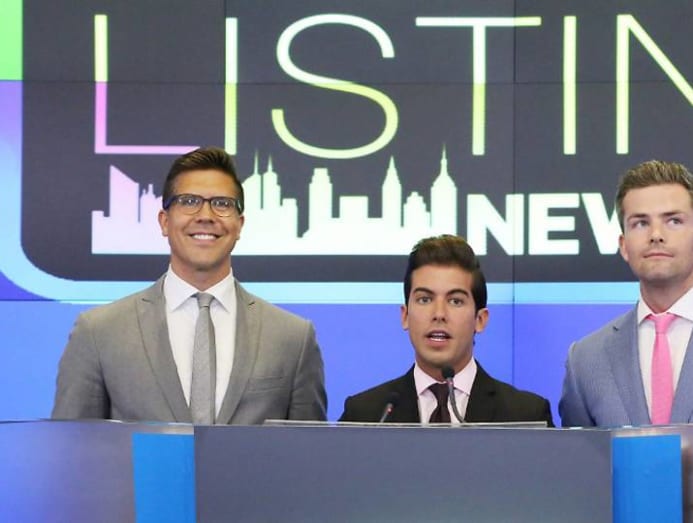
But the career move paid off. "Reality TV has boosted me." Information technology helped to brand the marketplace more than transparent, he added. "Social media and reality Tv has given insight into the agents' lives and allows the viewers to feel like they are in the abode with the amanuensis. In a competitive market everyone wants more eyeballs on the property."
Eklund has no divide between his private and public life. His Instagram account shows him with his picture-perfect children and husband, dancing with his kids to Let It Get from the film Frozen (with comments from the histrion Rebel Wilson), enjoying a altogether breakfast in bed with his family and splashing in the sea.
Then, of course, there are the houses. Some he owns personally, such equally the v,144 sq. ft. Connecticut summertime home with a pool and sauna that he hopes to rent out for U.s.$150,000 for the warmer months. But most of the properties he is selling on behalf of clients, such as the US$nine.7 million firm in 150 acres of country near Stockholm and the US$29 million mansion in Los Angeles.
A profile is adept for business organisation, he said. "You show all the colours of your personality. I'm not saying it'due south raw. It's thought out. I choose and think most what to share. If you follow the business relationship, yous hire me and you lot know what y'all get. That'south really good in sales."
Mauricio Umansky, celebrity founder and CEO of the Agency, a brokerage that sold the Playboy mansion in Los Angeles, has 400,000 followers on his Instagram account – though that is less than a fifth of his wife's followers. She is Kyle Richards, star of the reality Tv set show The Real Housewives of Beverly Hills.
On social media, he too mixes the personal with the professional person, showing pictures of himself working out in a branded T-shirt in his home gym, skiing and hanging out with his married woman in a luxurious tepee.
The properties are there, too: A restored 1926 Hollywood home with a castle-like outside; a Beverly Hills business firm that featured in The Godfather, offered at US$125 million. Umansky said his agents are independent contractors and not bound past employee rules. However, "If they were to break a confidentiality agreement and put [a belongings on] social media, that would be grounds for letting someone go."
Like Eklund, building a profile makes business sense, he said, citing the sale of a US$35 million estate to a celebrity who first saw information technology on Instagram.
Jenna Drenten, assistant professor of marketing at Loyola University Chicago, researches social media and professions. Instagram, she said, stokes the property appetite, assuasive everyone to meet seductive behind-the-scenes images, many of which were once only accessible through physical tours, with agents as gatekeepers.
"I choose and call back about what to share. If you follow the business relationship, you rent me and you know what you lot get. That's actually proficient in sales." – Fredrik Eklund
THE TRANSATLANTIC DIVIDE
The Britain does non have a breed of superstar agents like in the United states of america, despite Britons' appetite for property idiot box programmes such equally Thou Designs. Andrew Perratt, head of state residential at Savills, said this is in part due to the nature of the manufacture.
"The UK doesn't have a US-manner brokerage system, in which independent contractors work together under a make. In the US, [agents] are their own brand, so they take to promote themselves."
At Savills, a UK-based business concern that operates all over the world, private agents are discouraged from building their own profiles.
One London agent, who prefers non to be named, sees a cultural departure between the US marketplace and Britain. In the US, he said, there is no divergence between individual and business life. Instead, there is a preference for "perfectly conspicuous". "If yous sell self-deprecation in America information technology'south similar selling soiled underwear."
Henry Pryor, an contained UK buying agent and commenter who is active on Twitter, believes this is an outmoded view of the UK industry. While agents do not accept profiles like their The states counterparts, developers take hardly been shy and retiring.
The Candy brothers, for instance, are British property developers who were often photographed at celebrity events, with one marrying an actress-turned-popular star. Nicholas and Christian Candy, the developers backside the development 1 Hyde Park, opened in 2022 and once the nearly expensive residential development in the world, portrayed a flashy lifestyle that was key to marketing their high-end properties.
"The property business organisation is based on people rather than brands," said Pryor. "People want individuals – they pay a premium in America to become them. It'southward like getting celebrities to plough upwards at an result."
At that place are signs that social media is irresolute the property industry in the United kingdom of great britain and northern ireland. Grant Bates, associate director at Hamptons International, is based in due north London and has an Instagram following of more than 10,000. A abrupt dresser, he posts his musings on the holding market, video tours on interiors as well as details of Georgian town houses and Victorian villas.
Bates said he is encouraged to create his own brand as well as his employer'due south. While in the Britain the employer's brand is rex, he said that social media allows employees to personalise information technology. "Much of our business comes via word of rima oris or personal recommendation and social media can certainly assistance in this respect." In north London, Bates said, fifteen per cent of his sales last twelvemonth were generated via Instagram.
Chicago-based Melanie Everett, an contained amanuensis who specialises in urban residential property, said her Instagram account is half private life, half property related. Her Instagram stories include buyers in their penthouse, a "arctic dude" and his first condo, and a couple in their town firm. Another is near her life, including Bible study, a manicure and a four-course restaurant dinner.
Everett detects a generational difference in attitudes to social media, too. "The whole influencer matter is so big that brokers have seen it and applied it to their own earth." Millennials, she said, see social media as an extension of working life. Younger buyers want to know nigh the local community and lifestyle, not just the property – that is easier to portray through social media than brochures and spider web postings.
Eklund added: "In the beginning people were so horrid at [social media]. Not anybody should practice it. It'due south a skillset. I have more followers than some big existent-estate magazines have readers."
"The more than followers you lot go, the more than negativity you get." – Mauricio Umansky
He is unconcerned that most of his followers are unlikely to purchase one of his backdrop. "No 1 knows where the market place's going to come from," he said. "It used to be that you knew all the buyers in the expanse and controlled the surface area. We don't know where buyers are going to come up from. Yous need more eyeballs."
In recent months the coronavirus pandemic has suspended luxury-property markets, many of which were struggling with oversupply, including in London and Manhattan.
The virus striking but when New York's luxury market appeared to be recovering afterward a slowdown brought on past a glut, as well as a disappearance of Chinese and Russian buyers due to geopolitical tensions. Developers and agents were also dealing with a rise in the city's so-chosen mansion tax final year.
The virus has also interrupted the normal business of client meetings and viewings – although in some states in the Us, including California, the rules accept been relaxed. Social media has been an effective mode to reach housebound sellers and buyers in lockdown.
Over the by few months in Chicago, Everett's social-media strategy has been honesty. "I don't want to send the message that business concern is booming and everything is great, considering it'due south not. Coronavirus has been a gut-dial to my industry. I've been open nearly my anxieties online, and will keep to do so."
In one post she talks about her week beingness "filled with anxiety and fear".
In the United kingdom, said Camilla Dell, managing partner of Blackness Brick, an independent holding agent, some high-finish sellers practise not want an online presence due to "confidentiality and security… The belongings might have artwork and family photographs. Private individuals don't desire that kind of exposure or need that kind of exposure."
And so there are the rude posters, whom Umansky brushes off. "They can say, 'I hate the rich'. We've had properties, with people saying, 'I hate that house, I hate that style.'
"The more followers y'all become, the more negativity yous get."
By Emma Jacobs © 2022 The Financial Times
READ> Around the world, buyers are turning away from luxury backdrop. Here'due south why

Contempo Searches
Trending Topics
Source: https://cnalifestyle.channelnewsasia.com/people/real-estate-agents-are-turning-into-social-media-stars-247911
0 Response to "Real estate agents are turning into social media stars. But should they?"
Post a Comment